Characterize transcriptomic responses to valproic acid in a human-cell model relevant to developmental drug-safety research.
Model & Design
Human hippocampal organoids derived from the IMR90-4 iPSC line; day-57 cultures used for exposure.
Experimental Format
Expose organoids to 1 mM valproic acid for four days and compare with untreated contemporaneous organoids.
Model Components
Component
Human hippocampal organoids
Description
Derived from one female-donor iPSC line, IMR90-4.
Component
Valproic acid
Description
1 mM exposure beginning on culture day 57 for four days.
Component
Molecular readouts
Description
mRNA and miRNA sequencing, selected RT-qPCR checks and dual-luciferase reporters in HEK-293T cells.
Measurements & Endpoints
Differential mRNA and miRNA expression
Selected candidate miRNA-target reporter response
RT-qPCR expression of 10 selected mRNAs and selected miRNAs
Analysis
The authors compared treated and untreated organoids, linked miRNA and mRNA changes with predicted target networks, then tested selected candidate interactions in HEK-293T reporter assays. Sequencing used two biological replicates per group.
Published Evidence
Study Design
Four-day drug exposure versus untreated organoids at one developmental stage.
Study Sample
Organoids from a single iPSC line; two biological sequencing replicates per group.
Comparison
No-drug organoids; reporter constructs compared with corresponding controls in HEK-293T cells.
Finding
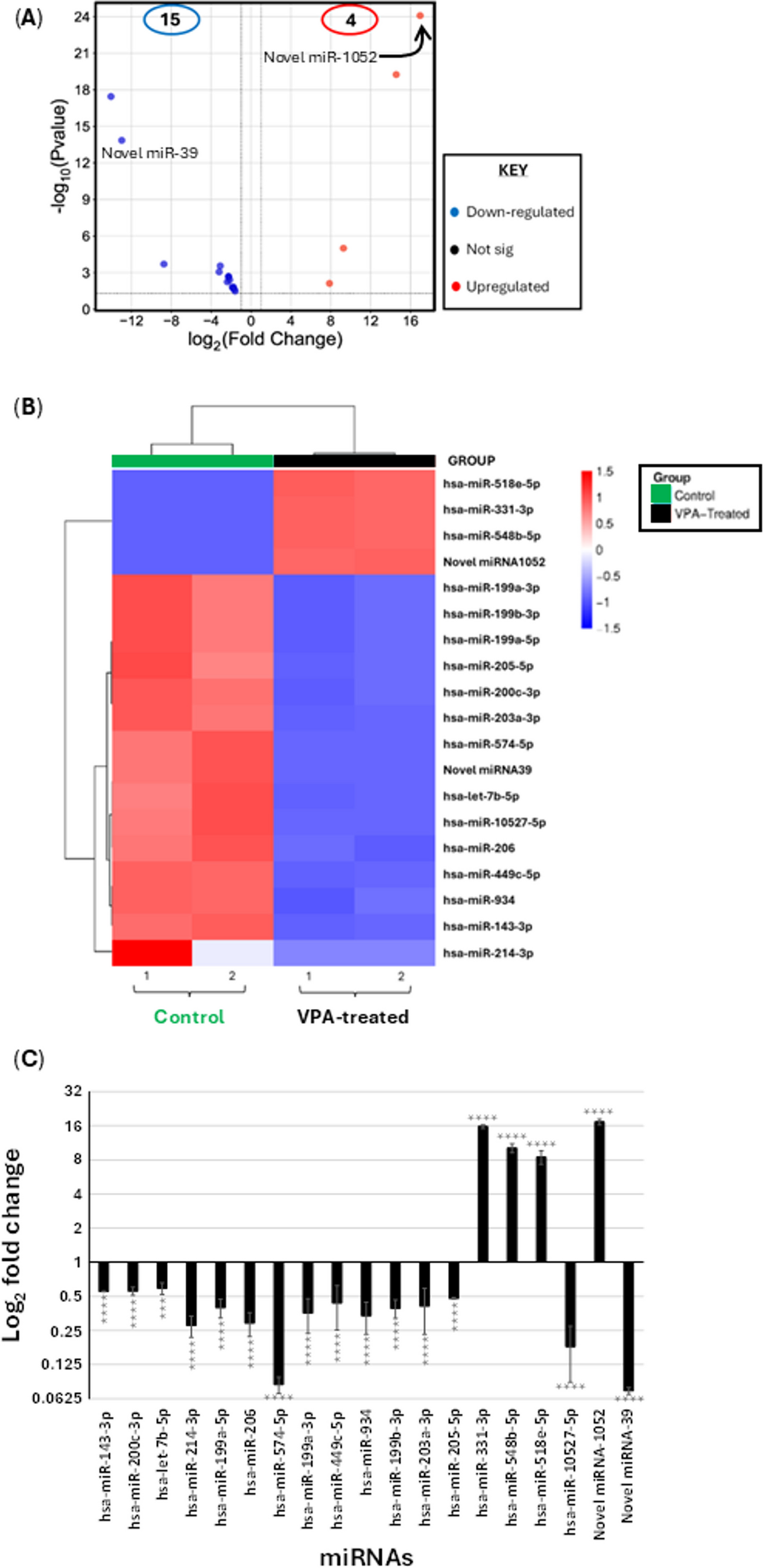
Nineteen miRNAs had altered expression, including Novel miR-39 and Novel miR-1052. Reporter effects supported TGFBR3 and GABRB2 for Novel miR-39, and NDEL1 and GPBP1 for Novel miR-1052; HS6ST2 did not show the same response.
Interpretation & Limits
Reporter assays were performed in HEK-293T cells, not in the organoids.
Small sequencing groups and a single iPSC line limit generalization.
No microglia or vasculature; molecular signals do not establish chronic neuroinflammation or clinical outcome.
Researchers exposed human hippocampal organoids to valproic acid for four days, then profiled mRNA and miRNA. They found 19 altered miRNAs and tested selected target sequences in HEK-293T reporter cells, with limited replication from one iPSC line.