What the Experiment Tested
An academic team at the University of California San Diego used cortical organoids derived from six independent human induced pluripotent stem cell lines to study direct exposure to acetaminophen. Beginning on differentiation day 21, organoids received the parent drug at 25, 50 or 100 μM, or a vehicle control, for five days. The investigators then examined morphology, gene expression, cell composition and neuronal activity at different stages of development.
The design addresses a narrower question than fetal drug safety in vivo. The organoids lack a placenta, liver metabolism, vasculature and a complete immune environment. In particular, the study cannot reproduce exposure to metabolites generated elsewhere in the body. The authors therefore interpret the findings as direct effects of the parent drug under the tested culture conditions.
The early exposure window was chosen to examine a developing cortical tissue rather than a mature neuronal culture. At this stage, the organoids contained organized neural rosettes: proliferating cells occupied progenitor regions, while neuronal markers appeared in more differentiated regions. The researchers assessed this organization alongside overall organoid growth. Rosette area and the measured Nestin and MAP2 signals did not differ significantly after treatment, providing structural comparisons for the subsequent molecular analyses.
Early Measurements Found Few Molecular Differences
Shortly after exposure, the team found no significant differences in organoid size, overall structure or apoptosis across the tested groups. Bulk RNA sequencing comprised 48 samples from six cell lines, four conditions and two replicates per condition. At the stated statistical threshold, there were no differentially expressed genes at 25 μM, 10 at 50 μM and 16 at 100 μM.
At approximately three months, single-nucleus RNA sequencing covered 55,665 nuclei from eight samples representing two cell lines and four conditions. The investigators did not detect a significant shift in the major cell populations or a persistent differential-expression signal in this subset. Cell-type proportions were calculated for each sample.
Most differentially expressed genes changed in the same direction in at least 60% of the cell lines. The researchers also examined whether coordinated groups of genes changed together, rather than relying only on individual differentially expressed genes. This network-level analysis likewise found no clear relationship with acetaminophen concentration, adding a complementary molecular comparison to the structural and cell-composition measurements.
Functional Follow-Up Remained Largely Unchanged
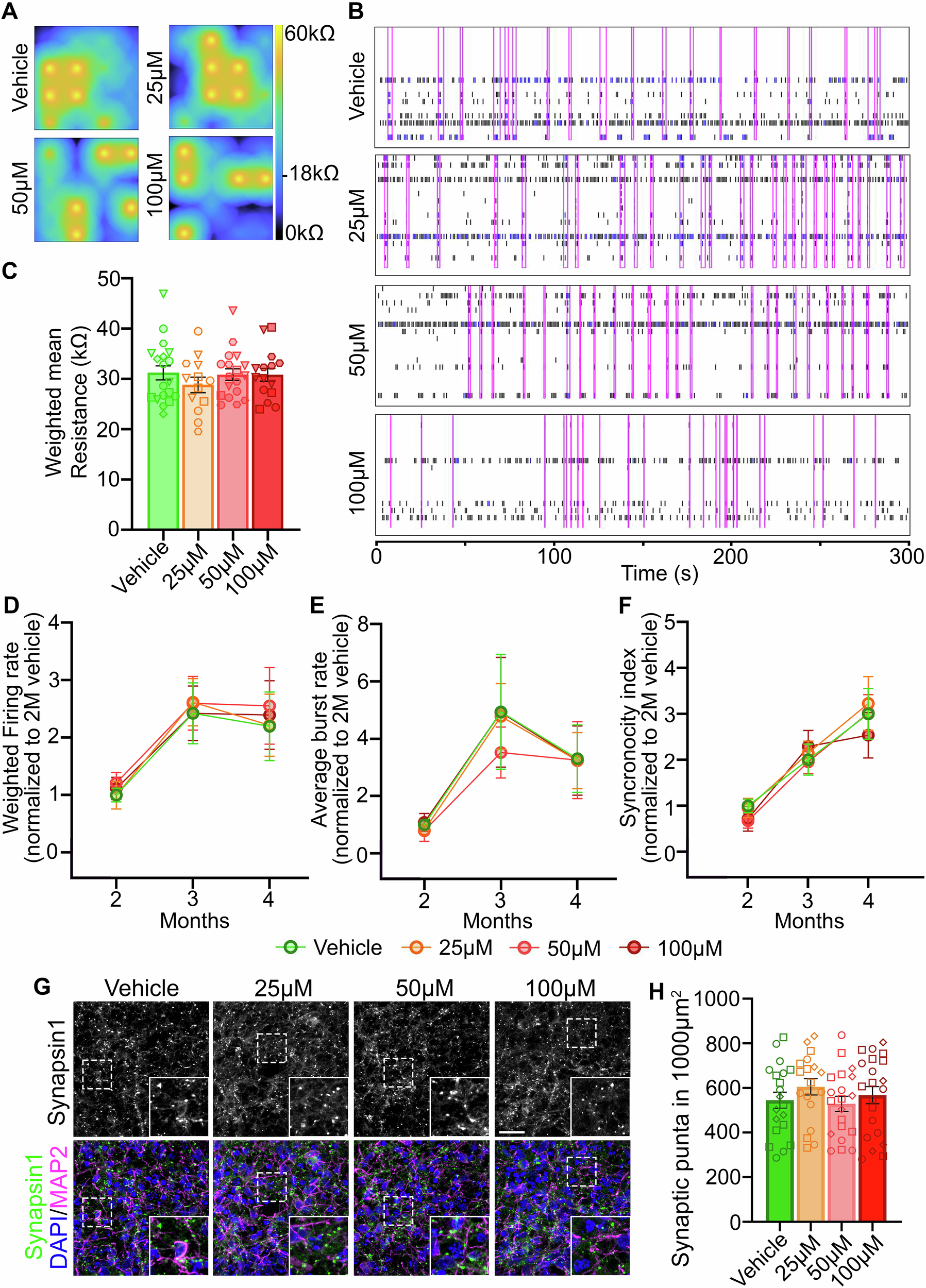
Multi-electrode array recordings followed spontaneous network activity between two and four months. The analysis in the primary paper involved five cell lines and at least 14 organoids across three batches. Firing, bursting and synchrony measures showed no significant between-group differences at the measured time points. Synaptic-puncta analysis at three months, involving three cell lines and at least 19 organoids, likewise found no significant differences in the reported markers.
These results provide evidence against large, persistent direct effects detectable by this particular panel after a brief exposure. They do not establish that acetaminophen has no developmental effect under different doses, repeated exposure, combinations of drugs or conditions involving systemic metabolism. The different readouts also used different subsets of cell lines and organoids; their sample counts should be read separately.
The staggered design could detect delayed changes even when early tissue measurements appeared unchanged. The later functional findings came from direct follow-up measurements, rather than an inference from the early sequencing result.