Direct Acetaminophen Exposure in Human Cortical Organoids
A human cortical organoid system combines morphology, gene expression, cell composition and neuronal network measurements after brief exposure to the parent drug.
Brain & Neural ModelsOrganoids
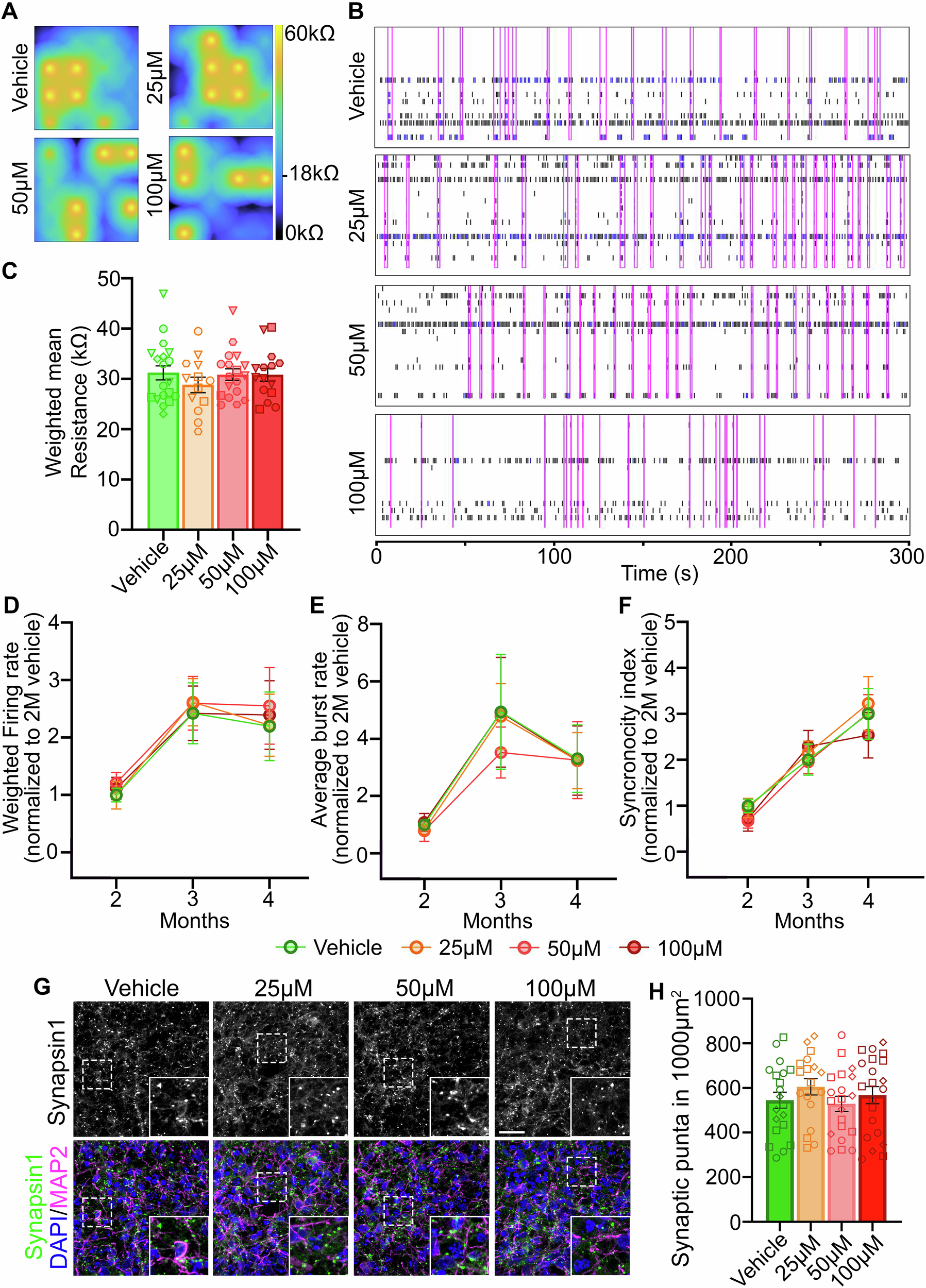
Electrophysiological activity and synaptic-marker measurements in acetaminophen-exposed cortical organoids (Fig. 6). (Luca Trovò et al., CC BY 4.0)
Research Applications
Study direct developmental-stage responses to acetaminophen and distinguish early molecular signals from later structural and functional measurements.
Model & Design
Cortical organoids derived from six independent human iPSC lines; individual readouts used different subsets of lines and organoids.
Experimental Format
Vehicle-controlled exposure to 25, 50 or 100 μM acetaminophen for five days from differentiation day 21.
Model Components
Component
Human cortical organoids
Description
Derived from six independent iPSC lines across the study.
Component
Acetaminophen
Description
Parent drug at 25, 50 and 100 μM, compared with vehicle.
Component
Complementary measurements
Description
Immunostaining, bulk and single-nucleus RNA sequencing, multi-electrode arrays and synaptic-marker analysis.
Measurements & Endpoints
Organoid size, structure and apoptosis
Progenitor and neuronal cell proportions
Early bulk and three-month single-nucleus transcriptomes
Spontaneous firing, bursts and synchrony at two to four months
Three-month synaptic puncta density
Analysis
Analyze each measurement at its own biological sample level. The bulk RNA experiment included line and replicate structure; network activity was followed longitudinally.
Published Evidence
Study Design
Five-day parent-drug exposure beginning on differentiation day 21, followed by structural, transcriptomic, cell-composition and later network measurements.
Study Sample
Six independent iPSC lines overall; bulk RNA sequencing used 48 samples. Single-nucleus sequencing used eight samples from two lines and retained 55,665 nuclei. Multi-electrode recordings involved five lines and at least 14 organoids across three batches; synaptic analysis involved three lines and at least 19 organoids.
Comparison
Vehicle control versus 25, 50 and 100 μM acetaminophen; a positive control was used for the apoptosis assay.
Finding
Bulk RNA sequencing found no differentially expressed genes at 25 μM, 10 at 50 μM and 16 at 100 μM. No significant later changes were detected in the reported cell-composition, single-nucleus expression, network or synaptic endpoints.
Interpretation & Limits
The readouts used different biological subsets; nuclei are not independent biological replicates.
The organoids do not reproduce placental or hepatic metabolism and mainly test direct parent-drug effects.
Repeated exposure and drug combinations were not studied.
Researchers exposed human cortical organoids to acetaminophen for five days and followed structural, transcriptomic and network outcomes for several months. Small early transcriptional changes did not translate into detectable differences in later cellular composition or the measured functional endpoints.