Predictions Were Checked Against Four Laboratory Endpoints
The National Center for Advancing Translational Sciences (NCATS) evaluated ADME@NCATS, its machine-learning platform for predicting properties relevant to absorption, distribution, metabolism and excretion (ADME), in selected Tox21 compounds. Tox21 covers drugs and other chemicals screened in cellular toxicity assays; activity in those assays does not establish what concentration a compound reaches in the body. The team compared predicted rat liver microsomal stability, aqueous solubility and passive gastrointestinal permeability with laboratory measurements in a selected set of 180 compounds. Eighty already had measurements in NCATS data, so those records were removed from model training before evaluation; the other 100 underwent new testing.
A separate arm evaluated passive blood–brain barrier permeability for 55 available acetylcholinesterase-active compounds. This was an availability-based subset, not a random sample of the Tox21 library. The researchers also assessed structural similarity to the model training compounds to identify where predictions might be less reliable.
The models learned from molecular graphs, using atoms and bonds to derive features rather than requiring a fixed list of precomputed descriptors. The laboratory endpoints nevertheless remained distinct. Microsomal stability addressed susceptibility to metabolic turnover, solubility addressed the amount that could remain dissolved, and PAMPA assays measured passive membrane passage. Their outputs supplied complementary pieces of exposure-related information; none represented the whole absorption or clearance process on its own.
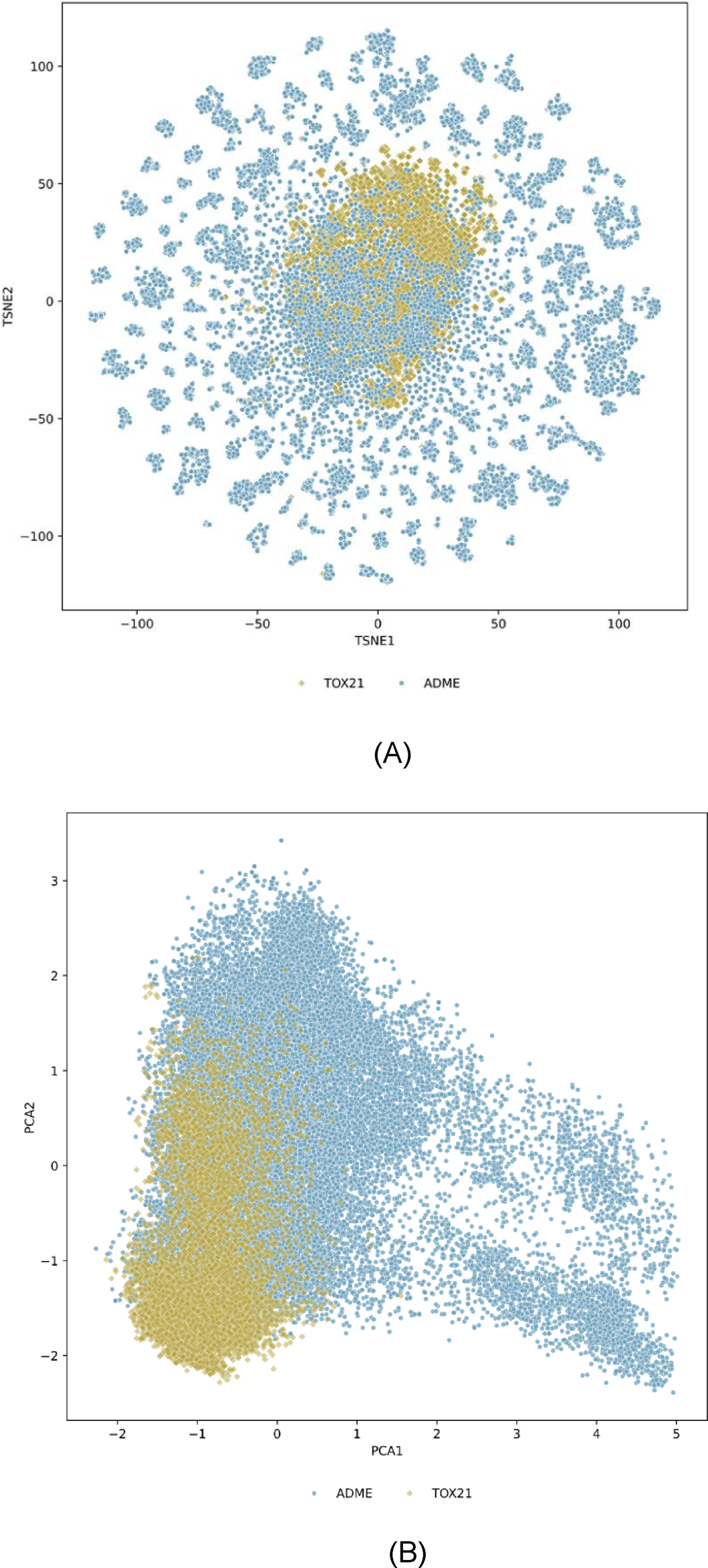
The comparison between the NCATS discovery collection and Tox21 was therefore part of the validation question. Although their chemical spaces overlapped broadly, some Tox21 regions had fewer close counterparts in the training data. The investigators combined global visualizations with compound-level similarity analyses to examine this distribution shift.
Performance Varied by Assay and Chemical Space
For the 180-compound evaluation, the area under the receiver operating characteristic curve (ROC AUC) was 0.87 for rat liver microsomal stability, 0.92 for passive gastrointestinal permeability and 0.81 for aqueous solubility. For solubility, overall accuracy was 0.83 but balanced accuracy was 0.75; sensitivity was 0.59 and specificity was 0.91. The gap between the two accuracy measures matters because fewer than one-quarter of the test compounds were in the poorly soluble class. About 40% of selected compounds had maximum Tanimoto similarity of 0.4 or less to the relevant training data, so predictions for less-represented chemistry need more caution.
The separate passive blood–brain barrier model reached an ROC AUC of 0.77 in the 55-compound set, with sensitivity of 0.68 and specificity of 0.85. Its PAMPA assay measures passive membrane permeability. It does not capture active influx or efflux transport, so a favorable assay result cannot be read as proof of brain exposure in vivo.
How the Benchmark Informs Follow-Up
The authors propose considering ADME predictions alongside Tox21 bioactivity when choosing compounds for further experiments. Their comparisons were conducted on selected laboratory test sets; they do not show that combining the two data sources improves prediction of in vivo toxicity or human risk.
The proposed decision tree starts with a biological activity signal, then asks whether disposition properties make particular follow-up experiments more useful. Among compounds with similar cellular activity, favorable passive permeability and solubility together with greater metabolic stability could raise the priority for systemic testing. Among acetylcholinesterase-active compounds, a favorable passive blood–brain barrier prediction could point toward CNS-focused follow-up. Conversely, a low score might redirect testing rather than settle whether the compound is intrinsically toxic.
The paper also compared its models with other available prediction tools. The authors caution that the test measurements came from NCATS assays and that other tools may target different endpoints or have different training data. Those comparisons characterize performance on the selected sets; they do not establish a general ranking of prediction platforms. Independent assays and transporter-aware models would address additional questions beyond this benchmark.