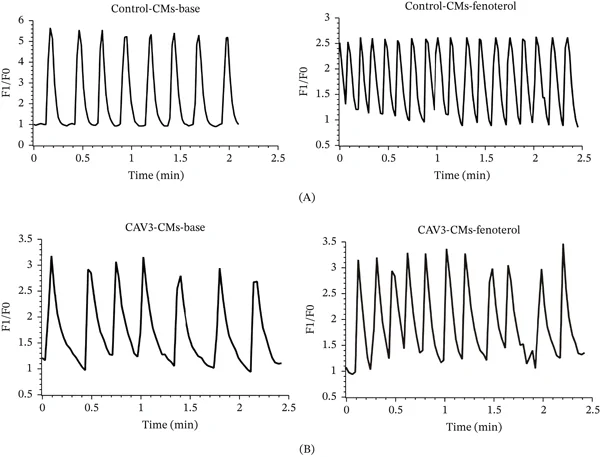
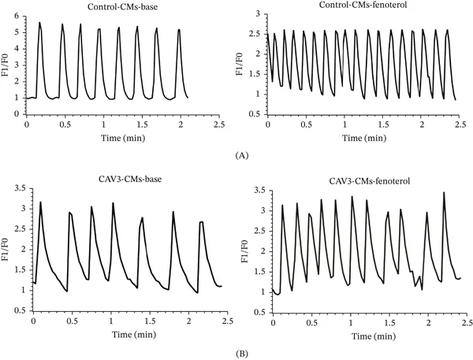
Examine whether a defined human-cell background shows different baseline or fenoterol-stimulated calcium activity.
Model & Design
Cardiomyocytes derived from one CAV3 p.Ala46Thr carrier and an unaffected sister without the variant.
Experimental Format
Protein imaging and ultrastructure assessment paired with Fluo-4 calcium recordings before and after fenoterol.
Model Components
Component
Cell identity
Description
Patient-derived and control iPSC lines differentiated to cardiomyocytes; control was a relative, not a gene-corrected isogenic line.
Component
Stimulus
Description
Fenoterol, a beta-adrenergic agonist, compared with each cell group's baseline activity.
Component
Measurements
Description
CAV3 protein localization, cell structure, calcium transient frequency and interval variation.
Measurements & Endpoints
CAV3 membrane versus perinuclear localization
Calcium transient frequency
Beat-interval variation
Basic cell morphology
Analysis
Keep cellular and donor denominators separate; compare both frequency and regularity rather than treating a faster calcium signal as functional normalization.
Published Evidence
Study Design
Variant-carrier versus unaffected-sister cardiomyocytes, each measured before and after fenoterol.
Study Sample
One donor per genetic background; CAV3 localization in 23 patient-derived and 22 control cells; calcium recordings from 13 cardiomyocytes per group across at least three experiments.
Comparison
Unaffected-sister cells and within-group unstimulated activity.
Finding
Abnormal CAV3 localization in 20/23 patient cells versus 0/22 controls. Fenoterol increased transient frequency from 2.8 to 4.4/min in patient cells, but interval variation rose from 22.73% to 31.42%; control frequency rose from 4.0 to 7.0/min with low interval variation.
Interpretation & Limits
The donor pair was not an isogenic gene-edited comparison.
Cell measurements do not establish patient-level cardiac risk or treatment benefit.
Cardiomyocytes derived from one CAV3 p.Ala46Thr carrier showed altered protein localization and irregular calcium transients. Fenoterol increased transient frequency, but the pattern remained less regular than in a relative's control cells.