Paired Glioblastoma Organoids and Primary Cells for Exploratory Drug Testing
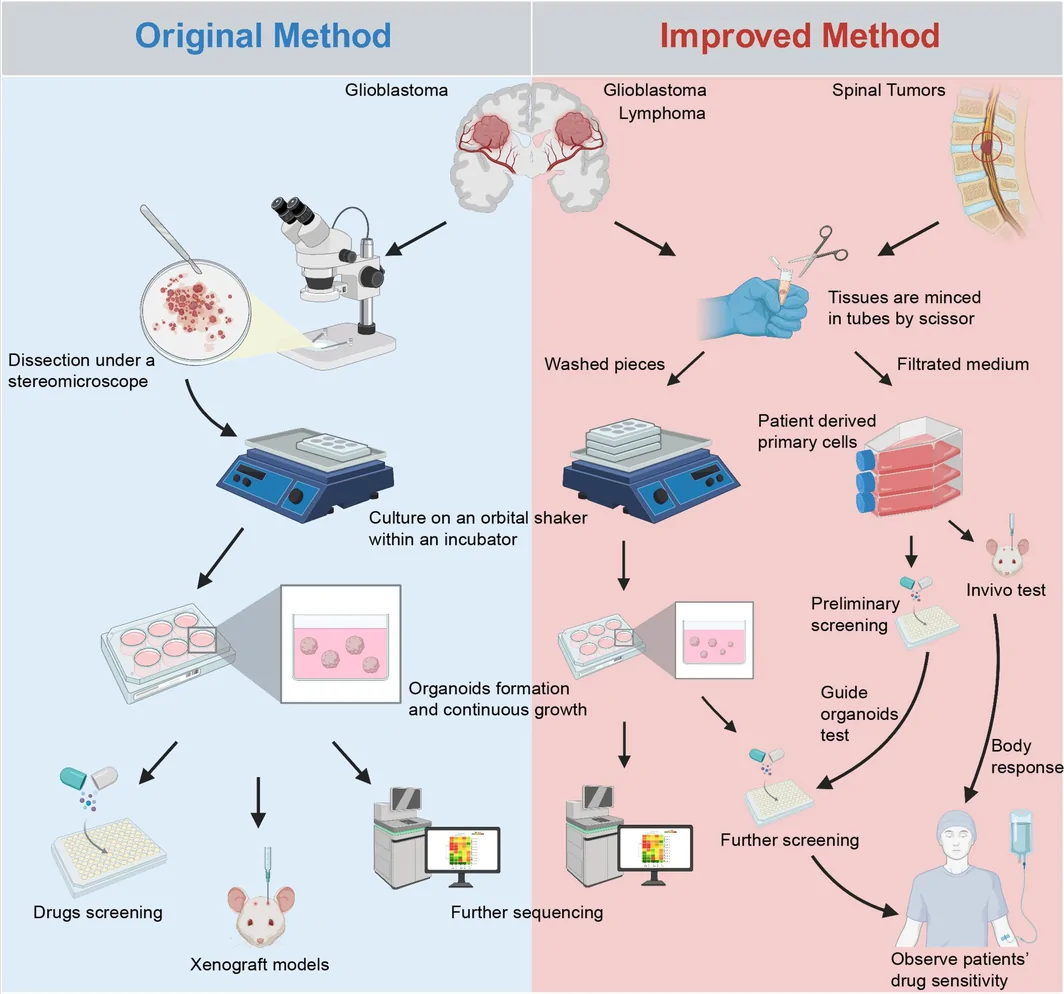
Organoids and primary cells obtained from the same tumor provide paired material for structural and molecular comparisons, with an exploratory two-patient temozolomide experiment.
Preserving matched two- and three-dimensional tumor models for mechanistic and drug-response research.
Model & Design
Fifteen glioblastoma organoid models established from 18 patient samples, with primary tumor cells recovered from material collected during preparation.
Experimental Format
Paired organoids and primary cells assessed by morphology, staining, representative matched sequencing and longitudinal projected-area measurements.
Model Components
Component
Patient-derived tumor material
Description
Eighteen glioblastoma specimens within a collection of 22 central nervous system tumor specimens.
Component
Drug comparison
Description
Organoids from two patients tested with 160 μM temozolomide or DMSO vehicle.
Measurements & Endpoints
Organoid establishment rate
Histological features
Variant overlap in representative matched tissue and organoids
Primary-cell CD133 expression
Two-dimensional projected area over time
Analysis
Retain the matched relationships between tumor, original organoid, passaged organoid and recovered material. Drug exposure lasts one week followed by two weeks of observation after withdrawal, with growth measured by projected area.
Published Evidence
Study Design
Representative structural and molecular checks, a two-patient organoid drug comparison and exploratory clinical follow-up.
Study Sample
Establishment: 15 of 18 glioblastoma samples. Drug testing: two patient-derived models with three organoid replicates per treatment. Sequencing overlap figures describe the presented matched comparisons.
Comparison
Matched tumor tissue, original/passaged/recovered organoids, primary cells from the comparison isolation method and vehicle-treated organoids.
Finding
Approximately 83% establishment success and substantial variant overlap in the representative comparisons; the two tested organoid models showed different degrees of temozolomide-associated growth response.
Interpretation & Limits
One of the two patients was lost to follow-up; the study does not estimate clinical predictive accuracy.
Recurrent post-treatment samples were harder to establish. Vascular representation was limited, and long-term adherent culture may alter primary-cell stem-like properties.
An academic team established organoids from 15 of 18 glioblastoma samples and recovered matched primary cells during processing. A two-patient temozolomide comparison illustrates exploratory use of the models, with very limited clinical follow-up.