Choose hepatic models and sampling times for drug-metabolism and ADME studies under steatotic conditions.
Model & Design
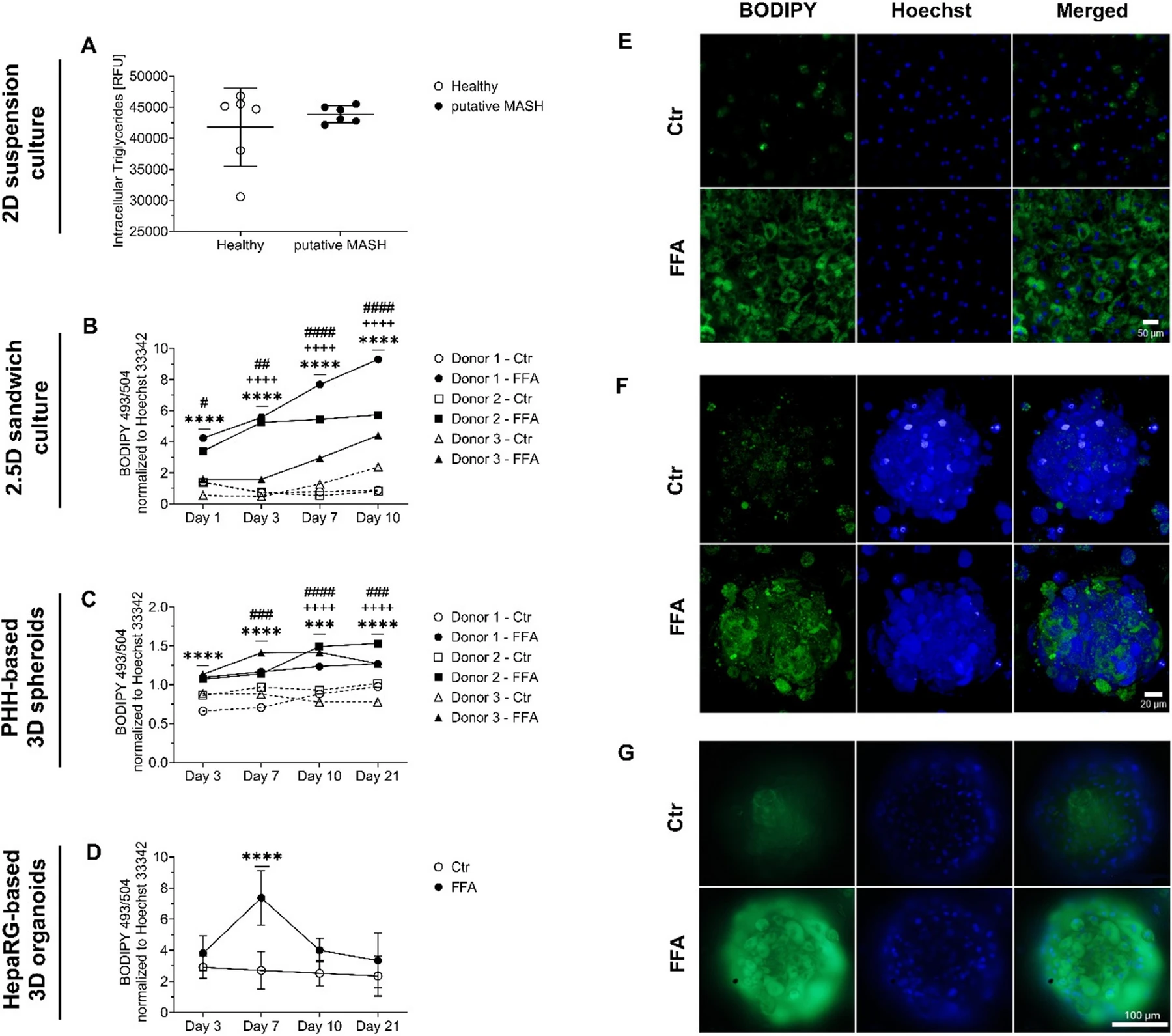
PHH suspensions, sandwiches and spheroids, plus HepaRG/LX-2/HUVEC micro-organoids. Suspensions compare donor groups; the other systems compare fatty-acid exposure with their own controls.
Experimental Format
Day-0 suspension, day-7 sandwich and day-10 spheroid/micro-organoid sampling. Induced systems use 600 µM oleic/palmitic acid at 2:1, with different carriers and media; micro-organoids use a matched methanol vehicle control.
Model Components
Component
Human hepatic systems
Description
Sandwiches and spheroids use three PHH donor lots; micro-organoids combine HepaRG, LX-2 and HUVECs at 4:2:1.
Component
Functional and molecular measurements
Description
Lipid staining, albumin/LDH/viability, a 33-gene panel and LC–MS/MS metabolites for CYP1A2 and CYP2C9.
Measurements & Endpoints
Lipid accumulation
Albumin, LDH and viability
Enzyme and transporter expression
Phenacetin and diclofenac metabolite formation
Analysis
Use within-platform controls and separate donor, independent-run and technical-replicate units. Donor comparisons are distinct from induced steatosis, and architecture alone does not explain cross-platform differences.
Published Evidence
Study Design
Phenotypic, expression and functional CYP comparisons across four hepatic systems.
Study Sample
Three PHH donor lots for sandwiches and spheroids; the suspension arm used six donors per group. Replicates differ by endpoint.
Comparison
Putatively healthy versus putative MASH donors in suspensions; untreated controls for each induced system.
Finding
Fatty-acid-related CYP changes depended on model and donor; neither CYP activity changed significantly in micro-organoids.
Interpretation & Limits
Suspensions and induced systems do not implement the same disease comparison.
Only two CYP functions were tested, without transporter activity or clinical clearance or drug-induced liver-injury risk validation.
A four-platform comparison combined lipid imaging, liver-function measurements, expression profiling and CYP assays. Lipid accumulation did not uniformly reduce drug metabolism, and differences depended on the model and donor.