A Platform Comparison With Two Types of Design
A team from the University of Tübingen and Boehringer Ingelheim compared four human hepatic systems: primary human hepatocyte (PHH) suspensions, PHH sandwich cultures, PHH spheroids and multicellular HepaRG/LX-2/HUVEC micro-organoids. The study asked how steatotic conditions affect liver function and drug metabolism, with the aim of choosing models for specific absorption, distribution, metabolism and excretion (ADME) questions.
Suspensions compared six donor lots per group, classified from provider records as putatively healthy or having metabolic dysfunction-associated steatohepatitis (MASH). This was a donor comparison, whereas the three longer-lived systems compared free-fatty-acid exposure with their own controls. Oleic and palmitic acid were used at a total concentration of 600 µM and a 2:1 molar ratio, but carriers and other medium components differed between platforms.
The sandwich and spheroid systems used three PHH donor lots. The micro-organoids combined HepaRG cells, LX-2 hepatic stellate cells and human umbilical vein endothelial cells at a 4:2:1 ratio. Lipid staining, albumin secretion, lactate dehydrogenase release and resazurin reduction assessed phenotype and function.
Lipid Accumulation and Culture Stability Are Separate Outcomes
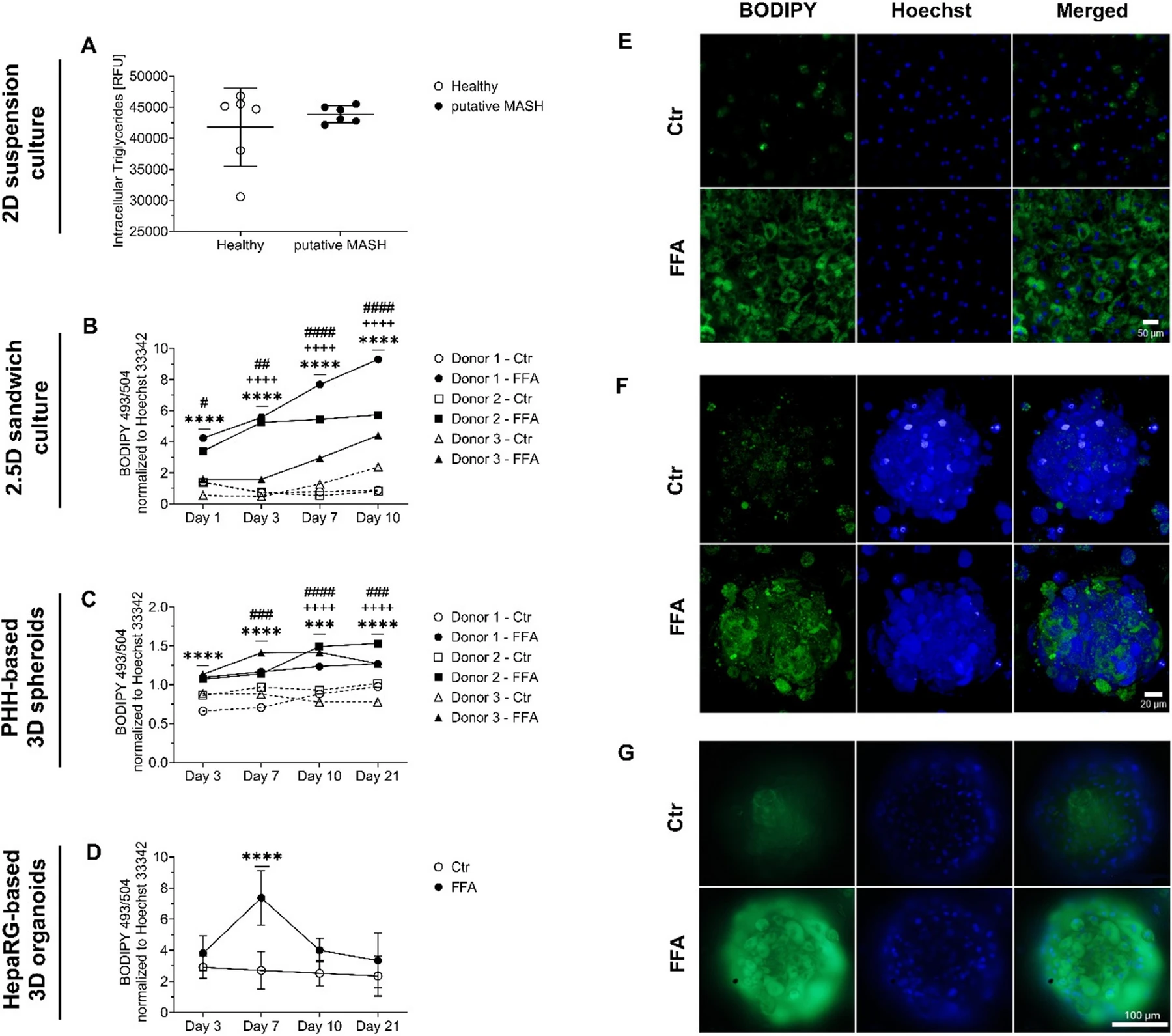
Suspension cultures showed substantial donor variability. Viability-related activity declined after 24 hours in the putative MASH group, yet initial intracellular triglycerides did not differ significantly between donor groups. The clinical labels therefore did not establish a consistently distinct disease phenotype in the isolated cells.
Sandwich cultures supported observations over ten days, while spheroids and micro-organoids allowed longer follow-up. Individual function measures still varied by donor and time. Fatty acids increased lipid accumulation in the induced systems, with different magnitudes across donors and platforms. The Results section reports that micro-organoid lipid content returned to baseline by day 21 after withdrawal of the stimulus on day 10. That recovery followed removal of the exposure; it was not a therapeutic drug-rescue experiment.
The size of the lipid response also varied within one platform. On day 10, the sandwich-culture lipid measure reached 10.4 times the untreated control in donor 1 and 1.9 times the control in donor 3. A shared fatty-acid ratio therefore did not produce a uniform phenotype, reinforcing the need to preserve donor-specific controls.
Functional CYP Measurements Differed From Expression Changes
The investigators measured a 33-target panel of enzymes, transporters and metabolic genes, then assessed CYP function through metabolite formation by liquid chromatography–tandem mass spectrometry. Phenacetin conversion to acetaminophen represented CYP1A2 activity, and diclofenac conversion to 4-hydroxydiclofenac represented CYP2C9. Sampling occurred on day 0 for suspensions, day 7 for sandwich cultures and day 10 for both three-dimensional systems.
In sandwich cultures, fatty-acid exposure significantly reduced CYP1A2 activity in donor 1, with no significant change in the other two donors; CYP2C9 declined in donors 1 and 3. In spheroids, CYP1A2 increased in donor 1, with no significant change in the other donors; CYP2C9 showed no significant change across the three donors. Basal activity was low, particularly in spheroids.
Neither enzyme’s activity changed significantly in the micro-organoids despite changes in several enzyme and transporter transcripts. Suspension variability prevented a consistent group difference in CYP activity. The findings show why increased lipid content or altered mRNA cannot be used alone to infer the direction of a metabolic response.
Micro-organoid transcripts that increased included CYP1A2, CYP3A4, UGT1A9 and ABCA1. Functional activity was not measured for every altered target. In particular, increased CYP1A2 expression was accompanied by no significant change in measured CYP1A2 activity, illustrating the distinction between the two endpoints.
Match the Model to the ADME Question
The authors position suspensions for rapid, short-term measurements, sandwich cultures for practical enzyme-induction and transporter-oriented work, and spheroids or micro-organoids for longer-term metabolic adaptation. This is a use-based interpretation of their different properties. Cell source, composition, medium, sampling time and substrate-incubation periods also varied, so the experiment did not isolate the effect of culture architecture.
The induced phenotype captures lipid accumulation and early metabolic stress rather than the full chronic inflammatory and fibrotic spectrum of steatotic liver disease. Functional testing covered only CYP1A2 and CYP2C9, and transporter activity was not measured. The study informs platform selection and interpretation; quantitative clinical clearance and drug-induced liver-injury risk were not validated.