Testing a Fragment-Based Strategy
A bioRxiv preprint posted on October 28 examines an adeno-associated virus serotype 6 (AAV6) delivery strategy in human induced pluripotent stem cell-derived cardiomyocytes (hiPSC-CMs) with heart-failure-like remodeling. The intervention expresses the human Cav1.3 C-terminal fragment, spanning amino acids 1840–2137. Earlier work cited by the authors links this domain to transcriptional regulation. The present study tests this fragment-based strategy through cellular functional measurements.
The team used one male and one female hiPSC line. Cells received 10 nM endothelin-1 (ET-1) for 48 hours from differentiation day 20; the fragment-delivery group received AAV6 on day 22, and measurements were made on day 30. Untreated cells, ET-1-treated cells and the ET-1-plus-fragment group were compared using gene-expression assays, patch clamp and contraction-video analysis.
Transcriptional Recovery Was Selective
ET-1 increased the hypertrophy- and remodeling-associated markers NPPA and NPPB by approximately 110% each relative to untreated cells; ACTA1 and COL1A1 increased by 144% and 166%. Their attenuation after fragment delivery did not reach statistical significance, and membrane capacitance remained elevated. Functional recovery therefore coexisted with persistent hypertrophy-related changes.
Among ion-channel genes, KCNH2 and CACNA1D returned to control levels after fragment treatment. CACNA1C showed a nonsignificant recovery trend, while SCN5A remained suppressed. The response therefore differed across the genes encoding potassium, calcium and sodium-channel components.
Repolarization Improved Despite Persistent Sodium-Current Loss
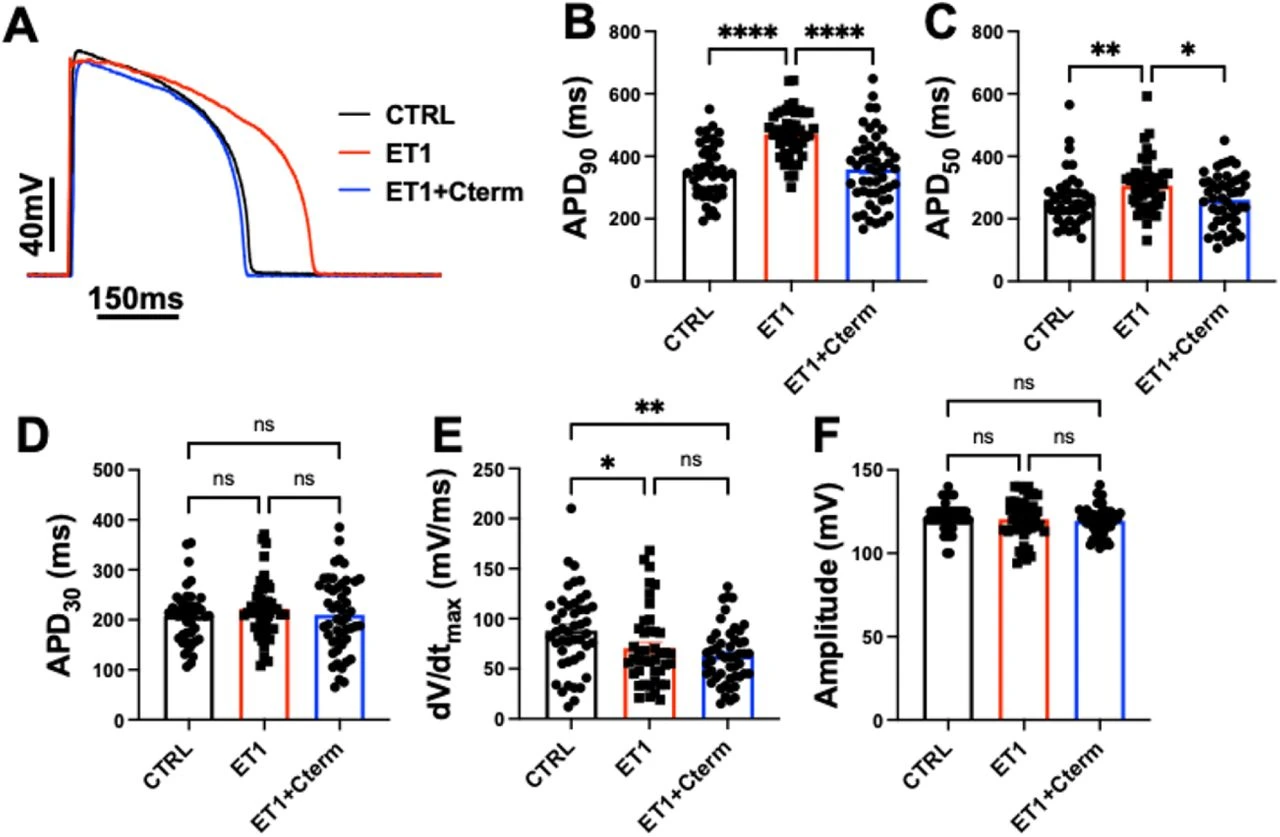
In room-temperature patch-clamp measurements at 1-Hz pacing, ET-1 prolonged action-potential duration at 90% and 50% repolarization by 34% and 17%, respectively. Both returned to control levels with C-terminal treatment. Action-potential duration at 30% repolarization and action-potential amplitude did not differ significantly among conditions. The ET-1-associated 20% reduction in maximum upstroke velocity was not reversed.
The current measurements showed a corresponding distinction. ET-1 reduced total outward potassium-current density by 30% at +40 mV and L-type calcium-current density by 40% at +5 mV. Both were restored to levels comparable to controls after fragment delivery. Sodium-current density, reduced by 50% at −30 mV, remained depressed. The shift in the voltage dependence of calcium-current activation also persisted.
Recovery of repolarization was thus accompanied by recovery of the measured potassium and calcium currents, while sodium current and the action-potential upstroke retained abnormalities. The study supports a selective electrophysiological response rather than uniform reversal of remodeling.
The action-potential comparison included 42, 46 and 50 recordings from the untreated, ET-1 and intervention groups, respectively.
Recovery in Video-Derived Contraction Measures
The contraction assay tracked particle displacement in phase-contrast videos of spontaneously beating monolayers. ET-1 reduced beating rate by 44% and contraction amplitude by 70%. With C-terminal delivery, both measures returned to values comparable to controls. Contraction time and relaxation duration showed no significant differences among groups.
The electrophysiology and contraction captions report three independent differentiations involving both cell lines. The gene-expression figure separately reports four biological replicates. These experimental levels are distinct from the numbers of individual patch-clamp recordings or contraction observations; the video assay quantifies motion-derived contraction amplitude.
A Human Model With Defined Limits
The work connects gene expression, ion currents, action potentials and monolayer contraction within one human-cell intervention study. Its negative findings are informative: improved beating and repolarization coexisted with persistent sodium-current loss and elevated membrane capacitance.
The authors discuss the immature features of hiPSC-CMs and the limited cellular complexity of cardiomyocyte monoculture. A dynamic clamp was used to maintain an adult-like resting potential during electrophysiology. Whether KCNH2 recovery reflects direct regulation by the fragment or an indirect response to altered calcium handling remains unresolved. The evidence is preclinical and comes from a preprint, with confirmation in more physiologically complex heart-failure models still needed.